
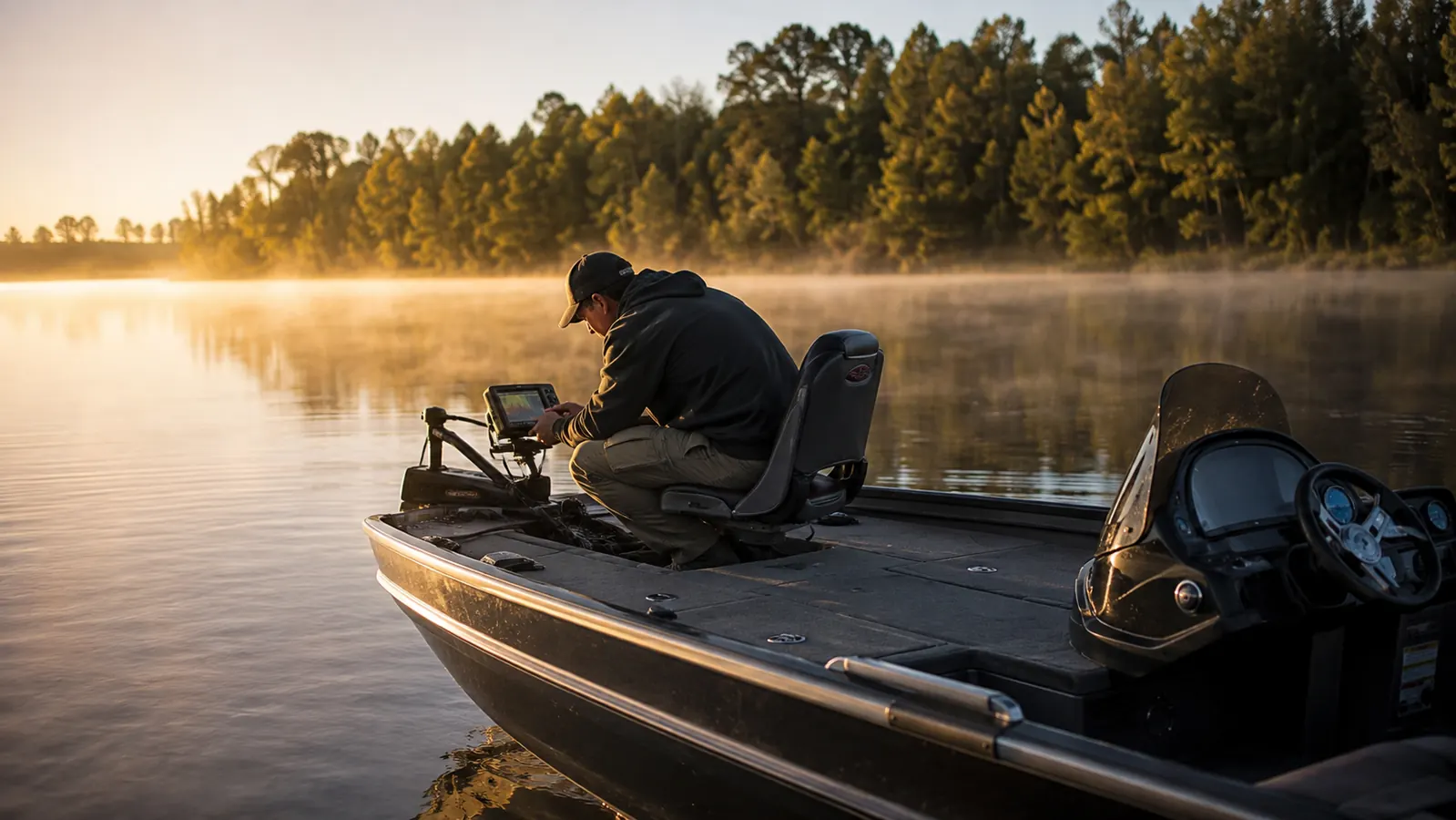
On a Saturday in late May, I idled out of the no-wake zone on Carter Lake and watched the bottom drop from six feet to thirty-four feet on the Garmin Striker 4 before I ever dropped a lure. I had fished that stretch of water for years on guesswork, and that screen showed me in thirty seconds why I rarely caught anything there.
That was season one. Since then the Garmin Striker 4 has ridden the bow of my sixteen-foot aluminum most every weekend from ice-out in April through late fall. I have marked just over two hundred spots, watched the screen wash out in July sun, and learned which arches turn into fish and which are noise. This is the long version of what three seasons on that screen taught me about my water.
The Quick Verdict
For a weekend boat angler who wants sonar and GPS on the bow without spending a fortune, the Garmin Striker 4 is the best value I have found. Plan on a sun shade and a better mount.
Amazon Check Today's Price →Put the Garmin Striker 4 on your bow this season
Check today's price on Amazon and see if it is time to start reading your own lake the way I read mine.
Amazon Check Today's Price on Amazon →How I've Used It
The unit came with a transom mount for the included transducer, and I started with the stock tilt bracket. It worked fine trolling, but at anything above a fast idle the head bounced and the screen shimmied. After the first month I swapped it for a cheap ball mount at the bow, wired the power to a fused line straight off the battery, and ran the transducer cable down the transom and up along the port gunwale. That is how the Garmin Striker 4 has lived ever since.
Most trips I run it from launch to takeout. Idling out, I watch depth and bottom type and mark any break, hump or weed edge I want to find again. On troll, I drop down to about one mile per hour along break lines and watch for bait arches stacked hugging against the bottom. On days when the screen is empty, I move. That alone ended most of the casts I used to waste in dead water.
Over three seasons that adds up to somewhere around sixty weekends, spread across Carter Lake most and Holloway Reservoir up north. I fish for bass and walleye most, some crappie in the spring. The Garmin Striker 4 has seen all of it, and it has never failed to boot or locked up on me. That is a low bar, but it is the bar that matters when you are two hours from home on a Saturday.
The way I use it changes with the season, and the screen rewards me for changing with it. In April I idle the shorelines slowly and mark the first green weed edges as the bottom warms. By June I am working the deeper breaks off those same spots. In October I go back to the April waypoints and run a crankbait over each one, because a point that held prespawn fish in spring almost always holds something in the fall. Same lake, same unit, three reads, and I never opened a menu to switch between them.
What the Sonar Actually Shows
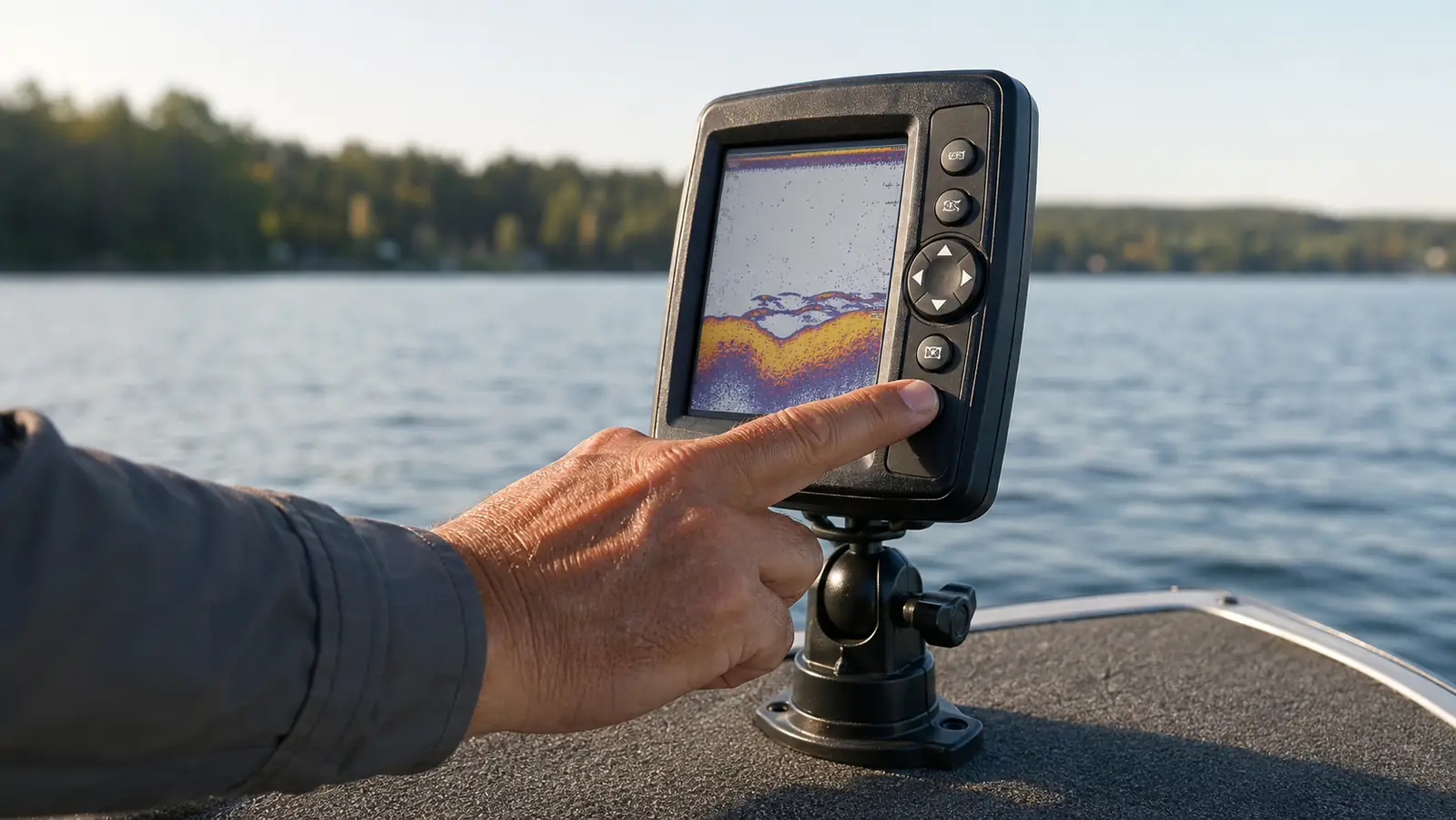
The first thing the CHIRP sonar taught me is that the bottom is not a line, it is a surface with texture. Hard clay and rock come back bright and crisp, soft mud comes back thick and fuzzy, sand sits somewhere between. Once you start reading that difference, you stop dropping anchor in places where the bottom does not hold fish.
The next read to learn is bait. The screen does not paint a picture for you, it shows returns, and learning to read returns is the whole game. A loose scatter of dots in the top half of the water is almost always nothing. A tight cloud hugging the bottom, thicker than the bottom line itself, is bait, and where bait sits, bass and walleye sit close by. The arches between them are the fish you came for, though not every arch is catchable, some are small, some are moving too fast, and some are just fish that will not bite what you have tied on.
Gain is where new owners mess up most, and I was no different. Month one I ran it hot, because hot looks impressive, every speck of debris in the water column lighting up. The screen turned into confetti. I dialed it back until the bottom return held solid and the tops of rocks showed crisp, and suddenly the arches that meant something showed up. On the Garmin Striker 4, restraint on the gain dial is worth more than any feature list.
One more read worth learning: water temperature. The included transducer reads surface temp. It is not a headline feature, but it is the one number I check before I pull the boat up on plane in the morning. Which sounds like trivia until you learn that bass move up the moment the surface temp crosses about sixty degrees, and then you fish the subtle difference between fifty-eight and sixty-two from the boat instead of guessing it from the weather report. It will not win you a bass by itself, but it decides where I start.
Wind changed how I read the screen before anything else about the unit did. On a calm morning a thirty-four-foot flat reads as a clean two-tone picture, bright bottom, dark water. Put a ten-mile-an-hour wind on it and the transducer picks up the churn, the anchor rope twangs, and half the picture turns gray. On breezy days I stopped fighting it, slowed the troll to a crawl, let the screen settle a minute, then read structure on the downwind swing. That one habit caught me more fish than any setting on the unit.
The GPS Marks That Changed How I Fish
The sonar finds the spot, and the GPS remembers it. That combination is the real reason the Garmin Striker 4 stayed on my bow. Every time I find a break worth fishing again, I press the mark button, and over three seasons I have stacked just over two hundred dots across two lakes. Some are points, some are weed edges, some are single boulders, and each one is a calendar entry I would otherwise try to carry in my head. I fish them in rotation, three or four marks a trip, so no spot gets pounded into uselessness.
On the Garmin Striker 4 I keep the waypoints numbered rather than named, and I log what each number was in a spiral notebook that lives in the console. It sounds old school, but it means a dot marked in May still tells me in October whether it was a gravel point or a rock pile, which is the difference between fishing a spot and wasting a stop.
The best example is a twenty-four-foot hump in the middle of Holloway Reservoir. I crossed it by accident in early November the first season, watched the return go from forty feet to twenty-four feet and back, pressed mark, and went on with my day. The next October, with leaves turning and water cooling, I idled out to that dot and caught walleye off it three evenings in a row. A bump pushed while trolling would have been a two-second memory. A marked waypoint turned into an annual appointment.
The other mark I would not want to lose is a brush pile in the north arm of Carter Lake, twenty-two feet down on a mud flat that looks like nothing from the surface. I found it one July afternoon when the bottom return changed from even mud to a ragged lump with bait ticks hanging over it, pressed mark, and left it alone all summer. The next fall the crappie moved in, and that single dot put fish on the deck four evenings in a row while boats without waypoints circled a hundred yards off.
The Transducer and the Mount: What Survived
The transducer has taken more punishment than I would ask of any gear. It has bounced off submerged logs twice, once hard enough that I assumed the reading would go fuzzy for good, and it has skidded across gravel when I beached the boat to stretch my legs. Three seasons in, it still locks onto the bottom cleanly at thirty-five feet, thirty seconds after the screen wakes up. It also sat through a frozen winter tied to the boat lift last year and read clean on the first trip of spring.
The mount is the other story, and the one honest disappointment. The stock tilt bracket lets the head slowly sag at speed, which turns the smallest vibration into a bouncing screen. A cheap ball mount swapped in after month one solved it permanently. The mount that finally held is why I trust the Garmin Striker 4 enough to run it at the bow full time instead of keeping it under the console.
Where It Struggles
The screen is the first honest con. The Garmin Striker 4 is a three-and-a-half-inch display, and in direct summer sun it washes out like a phone screen at full brightness on a deck. I hang a small sun shade over mine and still half the time I read it with a cupped hand. It is manageable, but it is real, and expecting otherwise will disappoint you. I keep a towel on the deck just for the screen, and on flat-calm mornings I park the boat so the sun is behind me.
Second, the unit will mark where you are and what you found, but it will not draw the lake for you. There is no built-in map or contour cartography; you are parking dots on a blank grid. That is fine when you run the same waters week after week, and less useful if you hop lakes every weekend with no marks saved.
Third, there is a real learning curve, and the first month I trusted noise more than I trusted the unit. Two weeks in I was convinced the screen was broken; it was my gain setting. That is why I keep telling new owners to spend an afternoon playing with settings before they spend a season trusting the screen.
The twenty-four-foot hump is a dot I marked in November three seasons ago, and it has put walleye on the deck of my boat every October since.
How It Compares to the Cheaper Alternatives
The natural comparison for most people is the Humminbird PiranhaMAX, which I ran side by side for a season on the same boat. The PiranhaMAX is a perfectly readable basic sounder, but it has no GPS, and when you fish the same water repeatedly, rerunning your own memories instead of a waypoint library is where the Garmin Striker 4 earns its keep. I break that matchup down fully in the side-by-side article, but the short version is that GPS is the difference.
Against the fancier console units, the Garmin Striker 4 gives up a bigger screen, mapping and networking, and it does not pretend otherwise. But none of that helps you on a sixteen-foot bow at six in the morning. What helps is a clean CHIRP return, a button you can press without looking, and a mark you can find next October. I would still take this bow sonar over a console screen I have to walk to. That is the whole argument for it.
What I Liked
- CHIRP sonar reads bottom hardness and structure clearly at the depths most weekend anglers fish
- Built-in GPS waypoints turn haunts into addresses you can return to all year
- The included transducer shrugs off rocks, logs and gravel that would end a lesser unit
- Simple physical buttons I can operate without looking away from the water
- A fraction of the price of console units that do the same core job
Where It Falls Short
- Screen washes out in direct summer sun unless you shade it
- Stock tilt mount lets the head wander at speed; plan on a ball mount
- No built-in mapping: waypoints are not lake maps
- Real learning curve on gain, frequency and reading returns
- Small screen that is perfect at the bow and hard to see from the console
Who This Is For
If you fish out of a boat most weekends, run the same waters again and again, and have not put sonar on the bow because you do not want to spend console money, the Garmin Striker 4 is for you. It is the honest value pick in the category, and three seasons have not changed my mind on that.
It is also a genuinely good first fish finder for a kayak angler or someone moving up from the bank, because it runs fine off a small battery, takes the bumps that come with smaller craft, and costs about what bankside anglers already spend on rods. If you want the ten reasons I think every boat angler needs one on the bow, that list is a separate article, but this is the unit I would start with.
Who Should Skip It
Skip it if you need the lake drawn for you. If you bounce from reservoir to reservoir most weekends and do not want to build your own waypoint library, a unit with built-in mapping is worth the step up. Skip it if you fish tournaments, where side-imaging, networking and a bigger screen earn their keep; the Garmin Striker 4 is not that tool. And if you fish exclusively from shore or a dock, sonar will mostly confirm what you already know about the water you can reach from the bank.
Your lake has spots worth remembering. This is how I keep them
Check today's price on the Garmin Striker 4 and give your boat the read that changed my weekends.
Amazon Check Today's Price on Amazon →