
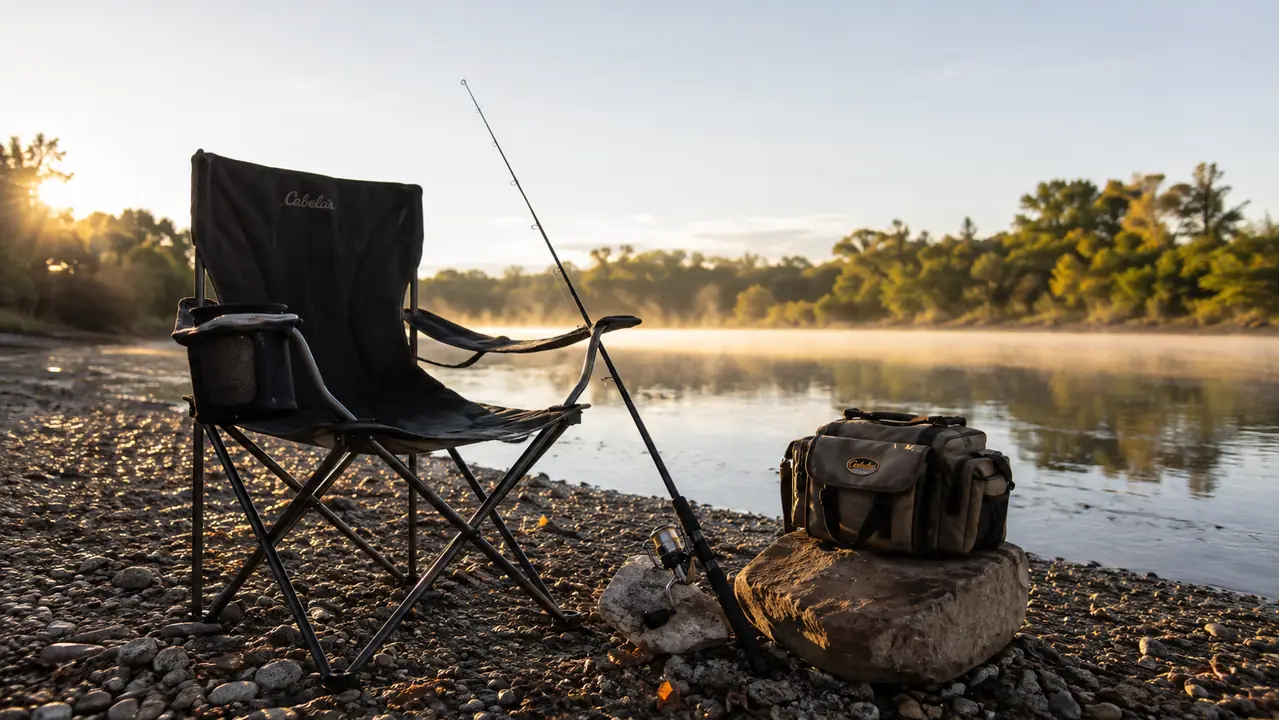
The listing photos show a clean chair on a clean patch of grass, cooler pouch zipped, everything square. You already know that photo is half the story, because every listing photo is. What nobody photographs is the same chair in July: what the seam under the cooler arm looks like after a season of full loads, how the chair sits when all four cans are in the pouch and the ground is lumpy, the way the bag balances when you have to carry it down a two-track trail and back up it. I have had this Coleman chair with the four-can cooler arm for one full season, and this is the honest version the listing leaves out.
Quick version for the impatient. It is a steel-frame camping chair with a padded seat and back, a mesh pocket that doubles as a cup holder on one arm, and a zippered lined pouch on the other arm that holds four standard cans. It ships with a carry bag and a shoulder strap. Since the first weekend of May mine has ridden behind the back seat of my truck to riverbanks, a gravel launch, two campgrounds, and every kind of bank a weekend angler actually sits on. This is the review I wanted to read before I bought the chair, and nobody had written that one either.
The Quick Verdict
The cooler pouch genuinely holds four cans cold into the evening and the padding has not flattened, but you carry close to ten pounds for it and the upright seat will not let you lean back. That is the honest trade.
Amazon Check Today's Price →The Four Cans Are Real. So Is the Weight.
This is the honest side of the Coleman chair: what the cooler arm does to the balance, which seam is the weak point, and who should buy a lighter chair instead. Read it, then check today's price when you are ready.
Amazon Check Today's Price on Amazon →How I've Used It
I am Cal, and I fish most weekends with the boat on the trailer behind the truck. This chair has spent the season in the spot the plain folding chair used to own, and it got there by being the thing I actually sit in: on a riprap bank while I waited out a slow bite, on packed dirt by a fire pit for a run of campfire suppers, and once on a boat ramp while I re-spooled a reel because the ground was wet and the cushioned seat beat a tackle bag. The best seat of the season was a shaded sandbar where I out-fished the dock crowd and never left the chair for a drink.
The honest version of my testing is that there was no lab. Fourteen weeks of the chair being the chair I sat in, including two weekends of rain and one evening when I leaned back harder than I meant to after a long day. That is the kind of use that shows you which seams are going to hold, which joints are going to creak, and whether the cooler arm is a party trick or a working piece of gear. It is a working piece of gear.
It carried more than me too. The mesh side pocket held my pliers, a spare spool of ten-pound line, and a small knife through the whole season without a tear, and rods and a landing net leaned against the arms more days than not. That is abuse the product page never mentions, and it is the test that matters.
The chair earned its keep one cool Sunday in September on a gravel bar above a bend that held smallmouth in the first light. By the time the sun cleared the treeline I had three fish on the stringer and had barely stood. My mug lived in the cooler arm, my hemostats in the mesh pocket, and the morning had a bench to run from. Not furniture. A command post with a drink in reach.
The Cooler Pocket Is Real, and Here Is the Fine Print
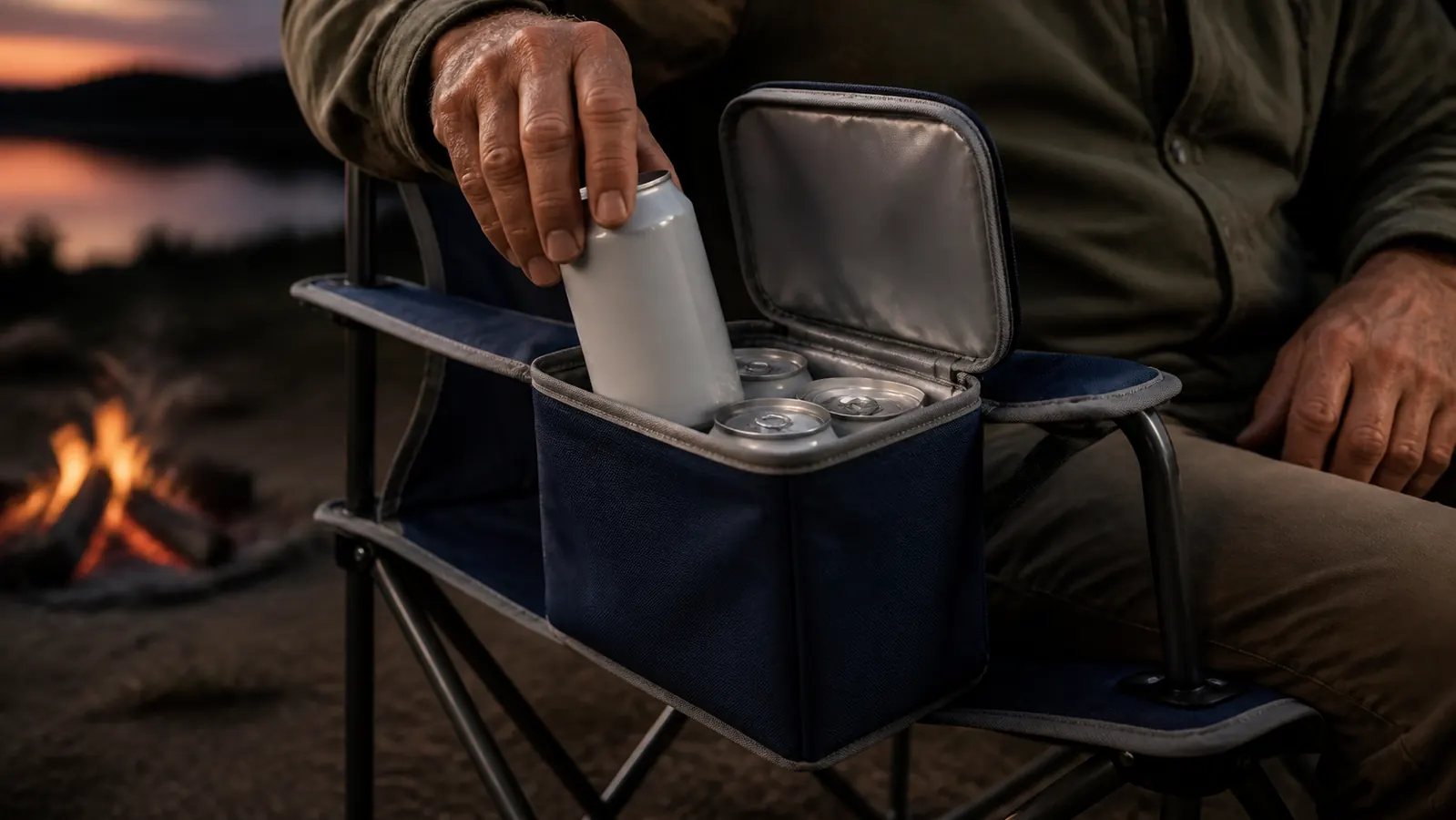
The four-can claim checks out. I counted twice. Four standard twelve-ounce cans sit flat in the arm pouch with the lid down, and a fifth only if you stand it in the mesh cup holder and call it a day. The foam walls do the insulating, and on a shady bank the cold lasts into the evening. In direct sun it runs out faster, and condensation collects in the bottom of the pouch, so that armrest stays damp until you wipe it out. I learned to snap the lid before folding the chair, or I am mopping the truck bed.
The fine print is the balance. Loaded, that arm gets heavy, the chair sits lower on that side, and you feel it the moment the legs find uneven ground. The bigger issue is where the weight lands. The full pouch sits directly over the seam where the arm meets the seat, which makes that seam the highest stress point on the chair. It is the one that will tell you, by the end of August, whether you have been careful all season. More on that in a minute.
On trips when the cans stayed in the truck, the pouch was not wasted. It held a phone out of the sun, a stringer of soft plastics, and a pair of sunglasses without sliding, and the lid snapped over all of it. The hinge at the back of the lid is the part I am watching next season. It takes the opening and closing every time the pouch changes jobs, and it is plastic where the rest of the arm is steel.
What a Season Does to the Fabric and Frame
The frame gets my respect. It is steel with a double cross brace, and it has carried my two hundred fifteen pounds onto gravel, dock boards, and lumpy campsite dirt week after week without the legs splaying or a rivet letting go. What you want to watch is the fabric where the cooler arm meets the seat. That is the pivot point for everything this chair does, and after fourteen weeks mine shows the start of a thread line under load. Not a tear. A warning that I should stop treating the chair like it owes me nothing.
On packed dirt the chair is quiet. On uneven stone it answers you, a low settle-and-complain sound as the frame takes the ground. I have seen guests lean in and ask if it is broken. It is not. It is a folding chair telling you the ground is lumpy, the way the boat tells you a wake is coming before you see it.
The fabric settled in the right way. The seat is softer than it was in May, the texture coarser where my elbows land, and the padding still springs back when I stand up. No fraying at the wear points, no split at the corners, which is more than I can say for the last two folding chairs I wore out on the same bank.
The chair saw two real storms, and the fabric beads water and the cushions stay dry through a passing shower. That is more than the last chair I owned could claim. The carry bag surprised me too. The zipper still runs smooth, the shoulder strap stitching has held, and the bag is snug, which is exactly why the chair folds up as compact as it does. The snugness is also why the first two folds feel wrong. They are not. You catch on by the third trip.
The Honest Weight Problem
Nobody leads with the weight because it reads small in a spec sheet. Close to ten pounds sounds like nothing in a listing and like a mistake by the time you are carrying it down a two-track trail with a rod case in the other hand and a bucket of bait in the third. The padding, the steel, and the foam walls all cost you something, and they add up. My plain chair without the cooler weighs several pounds less, and I noticed the difference the first week.
The shoulder strap helps, but the chair rides badly in the bag. The strap sits high and the bag swings, hanging off one shoulder instead of settling on your back, and after a fair distance you start trading hands the way you did carrying groceries in high school. Folded, the chair is wide, so it wants a dedicated spot in the boat or the truck bed. I pack it last and stand it on end against the cooler, and it has earned that spot.
Here is the honest trade. You are hauling a cooler you could have packed in a soft-side bag for a fraction of the weight. The reason to pay the weight is that the cold is right there, at elbow height, while you are already sitting in the chair. For someone who sits on a bank for three hours waiting on a bite, that is worth real weight. For a day hiker throwing a chair into a pack, it is not.
There is a trip I will not repeat. The walk was a soft mile of trail to a deep hole, the bank near vertical, and the cold drinks stayed with the cooler on the shore. I fished off a rock for half an hour, gave up, and walked back for the drink. The reverse has never happened. I have hauled this chair onto every kind of bank and campsite and never once wished it had stayed home. That one-way regret is the honest math of the weight.
On the boat it does not earn its keep. The benches are there, the livewell lid is there, and the chair takes deck space that a stringer and a net want. Mine has lived mostly ashore, and that is worth saying plainly. It is a bank and camp chair. On the water it is a spare seat for a dock visit, nothing more.
Where the Comfort Runs Out
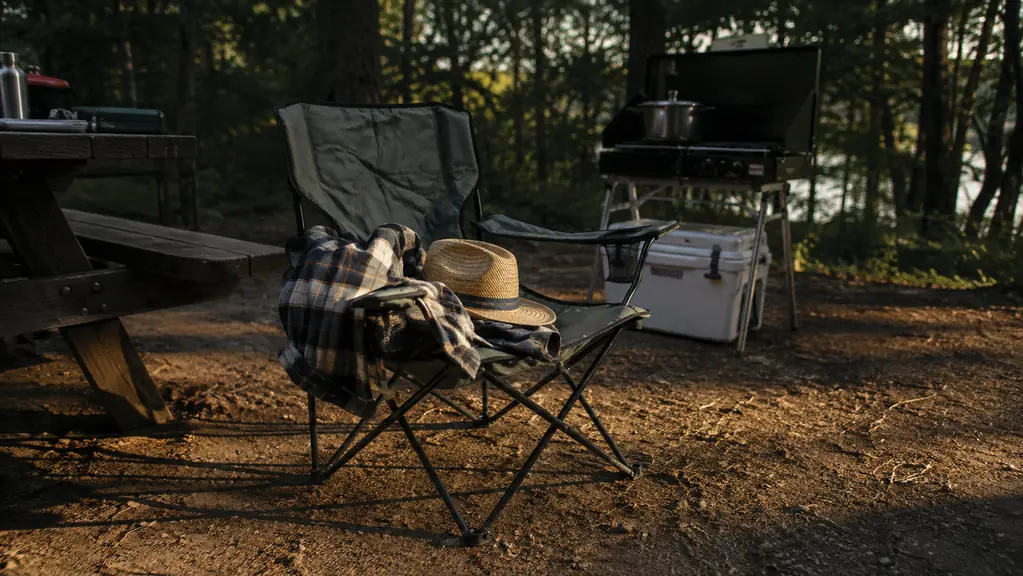
The cushions are the quiet feature and they are genuinely good. The seat pad and back pad are denser than the foam in most chairs at this price, and the first hour in this chair is a real improvement over any sling chair I have sat in. The limit is posture. This is a sit-up-straight chair. There is no recline, no way to sink back and put your boots on the fire ring, no lounging position at all. The back pad ends around shoulder-blade height, so there is no headrest for a long evening either.
The other honest note is getting out of it. The seat sits low, and I am six foot one with knees that have opinions, so I get up from this chair the way a man who has been on a rock all day gets up. It will never be the chair you nap in, and it does not pretend otherwise.
That limitation matters more at a fire pit than on a bank. Around a fire you sit for hours and you want to slouch and stretch your legs. On the bank you sit for twenty minutes between casts and then stand, so the upright posture is not a flaw, it is the point. This chair was built for the bank, and it shows.
If your evenings are lawn chair evenings, this is the wrong chair, and that is not an insult, it is a door. There are chairs that recline, and if your ground is soft grass instead of gravel, the honest comparison will matter more to you than it did to me. I kept this one because my ground is almost never grass.
What I Nearly Bought Instead
The plain Coleman chair without the cooler is the first honest alternative. It is cheaper and it is lighter, and for a quick morning at the river with one drink in a thermos, it is the smarter buy. I borrowed one in July. By the second hour I was walking back to the truck for a cold can, which is exactly the trip this chair saves you.
The other chair I keep meaning to run for a full season is the GCI Kickback Rocker. On soft grass and deep sand it is the more comfortable chair, full stop. On a gravel bank and a boat ramp a rocker wobbles and digs and never settles, and my weekends are gravel, dock boards, and mud flats. I ran the two side by side for an afternoon, and the honest results are in the comparison I wrote.
So the decision turned out to be simple once I stopped shopping for the chair I wished I owned and bought the chair for the ground I actually fish. For hard ground next to water with a stringer in the shade, the cooler arm pays for itself in the first month. If your camp is a lawn, buy the rocker. If your camp is a shoreline, start here.
Four cans in the pouch, two hours of campfire, and the one in my hand came out cold enough to ice a sunburn. That is the whole case for this chair.
What I Liked
- The arm cooler genuinely holds four cans cold into the evening, not a gimmick
- Denser seat and back cushions beat every sling chair at this price
- Steel double-cross-braced frame carried 215 pounds all season without a complaint
- Mesh side pocket carried pliers, line, and a knife all season without tearing
- Carry bag and shoulder strap included, and both survived the rain
Where It Falls Short
- It is heavier than it looks, close to ten pounds with the bag, and it rides badly on the strap
- The loaded cooler arm costs you the elbow rest and dips the chair on uneven ground
- The seam under the cooler arm is the weak point and needs watching
- Sit-up-straight posture only, no recline, and the low seat makes getting out a project
- On the boat deck it earns nothing, it is a bank and camp chair
Who This Is For
This chair is for the person whose camp is a hard surface: a gravel bank, a boat ramp, a tailgate, a packed campsite. It is for the bank angler who would rather drink what they brought than walk back to the truck for it, and for anyone tired of re-buying folding chairs that sag by the second season. I am that person, and this is the first chair whose padding has held on long enough to turn into a recommendation.
Who Should Skip It
Skip it if your fishing involves a walk, because close to ten pounds of chair on a trail beats you up by the time you reach the water. Skip it if you want to recline after supper, since this chair sits you up and that is what it does. Skip it if you camp on soft grass, because a rocker is the better chair on that ground. And skip it if you are the one who always packs the lightest, because this will never be the lightest thing in the truck.
The Ground Will Still Be Hard Tomorrow. It Does Not Have to Be.
Fourteen weeks in, the cooler pouch still holds four cans cold and the padding has not flattened. That is the honest version, weight included. Read the whole thing, then check today's price when you are ready.
Amazon Check Today's Price on Amazon →